How goes “The Great Commission” in your church?

The Matthew 28 passage presents us with “The Great Commission,” as these are the marching orders for our faith and practice! This is also the hallmark passage for evangelism and missions! This is the climax of redemption and the critical call of the Church. This passage contains the ultimate wonder of the universe-the incredible impossible, and the incredible triumph. Jesus was crucified; He died, and was buried.


The-great-commission


What does make disciples mean to your church? What has your church done with Christ’s most important call? Why do so few churches and Christians do this?


The history of man, his fallen state, the move of our Lord though history and our lives has interwoven to the finishing point. He lived on our behalf. He has died in our place to absorb God’s wrath and pay our debt of sin; now, He rises back to life, conquering death, and giving us victory and grace for a life of fulfillment and fullness (Psalm 16:11; 107:09; Isa. 26:3; John 14:21; Gal. 5:16; 22-23; 1 John 1:7-9; 3 John 4)! 

Let’s look at what this all means: 

“Make disciples” literally means someone who pledges to be a “learner.” Moreover, it is someone who follows another’s teaching, and adheres to it. It is a commitment and a process. It involves commitment, and time to undertake the learning, and, as a Christian, a yearning to imitate Jesus!  

This refers to what rabbis did, that is, take people under their wing and teach them the Scriptures and procedures of the Temple and life. Thus, they could then become rabbis, and so forth. There were few formal schools then; and, even after going to a formal school as Paul did, becoming a disciple was still paramount, as it is yet today! The Jews baptized, but not in the name of people, but rather, for repentance. Jesus is God and He saves; we respond by repenting (Matt. 4:17; Eph. 1:3‑14; 2:8-9; 1 Cor. 1:18‑2:16; 15:1‑8).  

The difference is that rabbis made disciples like themselves, with their traditions and beliefs. We are called to make disciples like Christ, and teach His precepts and ways!  

“Baptize” meant conversion and identification; the person was to become identified as a person of faith and as a follower of Christ. It does not presuppose a ritual, but rather a mindset. The physical act of baptism is essential (not for salvation), as it is a public showing of our faith and commitment. The specifics of how and when are not as important as the faith and obedience to follow Christ (Matt. 4:18-19).  

“Teaching” means to show what is in the Scriptures, how to understand God’s Word, what is God saying to us, and how to live by God’s Word. Personal instruction helps us understand and then apply His precepts into our lives. We are to live for Him and to serve Him. For the rabbi, this meant the Law, Commandments, and the Prophets. Now, it also means the teachings of our Lord.

“Observe.” We are called to learn what to believe and to obey. We do this by observing; it is cemented in us by doing! This passage is called “practical holiness.” Jesus calls us to observe (to learn and grow) and then to do it!  

“Always be with you.” The great comfort we have is that the God of the universe, our Creator and Lord, knows us, loves us, and will be with us! This also refers to Jesus being fully God. One of Jesus’ names is Immanuel, which means “God is with us (Matt. 1:23).”  

To make this all work, the remaining disciples had to surrender their will to His in order to know who He was and what He was doing in them (John 3:30). 

We cannot make disciples of others until first we, ourselves, become disciples of Jesus (2 Pet. 1:13)! 

The disciples bore witness to His call to make disciples of all nations; they were His witnesses and His messengers. What will you do about this today (Acts. 1: 22; 4:2, 10, 33; 2 Cor. 5:20)?

 The key to implement this is to realize who Jesus is-and His authority! When we have acknowledged His authority, then we can allow His work in us. Then, He can use us in the lives of others. The opportunities and potentials are limitless (Luke 10:17-20; John 15:7; Acts 20:24)! 

What can you do to help your church see the veracity of The Great Commission and do a better job of knowing Christ so they can then make Him known? What would your church look like doing this? What would your neighborhood look like?


http://www.churchleadership.org/apps/articles/?articleid=42799&columnid=4540

Is your Church pointing to Christ or to something else?

We got trouble in our churches–a lack of loyalty. A tough question needs to be asked of ourselves, are we being “harlots” with His Church? 

Read Revelation 17-18

Yes, there are far better ways to make a point than to use the “harlot’. However, this is the word God uses, and it may wake us up to our dysfunction and the predicament we have in how we lead and manage churches these days.

God is calling you and me–those who lead and pastor churches, who influence people in the church, who sit on committees, teach, or the like to flee from manipulating and gossiping behind the scenes-to wake up and SEEK HIM, not ourselves or ideas or plans or trends! The problem is, many of us are doing the opposite!

The main prostitution we should worry about as Christians is Church Leadership falling to pride, apostasy, and the ways of the world versus faithfulness to Christ! 

So, how is your loyalty to Christ?  

Here is a simple test to see if you or the pastor is loyal is this.  Does the teaching and character point to Christ or point to themselves or something else?  Does the first response and vision showcase the Lordship of Christ or the way I want things? What does Christ call us to do and what betrays Him?

  • Is our church about a personality or a Person?
  • This is about who you pledge your life to.  Is it to your own pride? Or, is it to His Church and the glorification of Christ?
  • Or, do you chase bad trends, sins, and the ways of the world?
  • Are you so concerned with your way of doing things that His Way is pushed aside or skewed? 

The bad pastor and church leader is into themselves, and they lead their people away from God’s path, becoming disloyal to God and His true Truths to the point they blaspheme God.  They focus their people to trust in materialism and trends that neuter the Bible, water down His Word and replace discipleship with entertainment and lead others to do so, too.  In so doing, she is not ashamed, but rather boisterous and proud of sin. 

Why is this so important?  

Our loyalty helps us lead the life that bears the life of Jesus, the character of Jesus and the theme of what it means to be a real authentic effectual Christ like Christian. This is the essential mark, the most important thing we can accomplish in our life, to be Fruitful, to be faithful and be His and act like it. This means to allow the Holy Spirit to nourish and energize us, to speak to us and work in and through us.  

Do you want to be safe and adequate or powerful and used in ministry and life?   Really think about this.  We do not have to lead the Christian life as a Christian.  We can peach merely feel good messages do not instruct or edify.  

We can be bullies in the boardroom or apathetic and uncaring and even obtuse to our families–frankly, most of us are.  We don’t live with Fruits of the Spirit. As a pastor, may I say honestly, very few Christians do.  Few pastors do. I met very few real Christ-like fruitful pastors in my thirty plus years in ministry. This is sad.  Most of us just do not get it.  We live our lives to ourselves.  It may not be outright sin, but it is placing our desires first, and we do not want to learn and grow. We do not what to be convicted and grow beyond where we are.  

Most pastors do very little time to build their spiritual life. That is why the cheap messages that tickle our ears and move our emotions are so popular—more popular than the meat of the Word of God.  It is why so many of us stopped growing so we stopped teaching.  We created congregations who want to be told, we are OK, we want to hear encouragements and feel good stories, and we do not want to be taught the true Truth of Scripture so we can be used to further renew and transform the people in our care by the example and flow the Fruit of the Spirit.  

The main call for us is to heed Christ’s love, grace, and call, and that any evil power–past, present, or future–is not to be feared by us Christians!

The phrase, God has put it in their hearts, refers that He is still in control.  Even when the world seems to be in chaos and discord, He is there with us, ever faithful and still in charge.  Our duty and call is to fix our eyes on Christ, not on the troubles.  This is the key to dealing with suffering and when life does not seem to make sense. The answer is not making up our own Gospel or changing His Message to our own (2 Cor. 4:18; Heb. 12:1-3). 

Do not refuse God.  Teach, preach, be loyal, be fruitful, be faithful, be real for Christ and live it out.  By our example, we are used for His glory, giving people known and unknown to us a chance to repent and be saved. 

Are we being “harlots” with His Church?  If so, stop, pray, and get right with God. If you can’t, then get out of leadership until you are right with God and His call and His precepts! 

More here: http://www.churchleadership.org/apps/articles/?articleid=84331&columnid=4544


The Call for the Church from EPHESIANS PII

His intent was that now, through the church, the manifold wisdom of God should be made known to the rulers and authorities in the heavenly realms,

Peace is the positive hope of Christ clearly taught and given to others in loving and caring ways.

The church is to be the beacon of light first before she can take a stand.

A “stand” born out of chaos and division is a foolish endeavor, because the credibility will not be there nor will the true purpose of the church be communicated correctly. The church is the result of reuniting; thus, our teaching and determination proclaim the reconciliation we received to those who have not received it, and in turn remind us of our gift. In Christ we are united; do we set that example and show it both publicly and to one another? Just as the Jew was united with the Gentile, we are to come together with one another for our Lord’s purpose and to excel in His call.

We are to learn and to grow in our relationships and knowledge of our Lord. The wisdom of God is to be made known.

We cannot do that if we are so busy fighting with one another. We must realize that God will not allow His message to be thwarted by our pettiness. We cannot be hostile to our Lord as the Demons or the unsaved are. We must be set apart to be a peculiar people and a mirror to His majesty. The love of our God is to be known and expressed by His followers and made known to others.

Our weakness and feebleness will not get in the way of our Lord’s final purpose and will. So, we need to take comfort in His purpose and holiness, confident that He will guide and lead; we need only respond. Yes, we will make mistakes (and God knows I have made a boat full over the years), but our comfort is that it all does work to His glory. The point I need to make is this: we can do better, and His plan is better than ours. Character is the outgrowth of our struggles and obedience that will be used to further His Kingdom. We do this as a united body, rich in our Lord and committed to His cause. We model this with integrity, honesty, and care, with love as our drive, pointing to hope in His name. Our weakness becomes our strength because of His work in us.

Christ is our head, and when we do not get this essential fact, we will spill our “disease of disgust” instead of blessings from His presence.

We are to give God the glory in all we do so our triumphs will be His and our failures will also be His; our Lord reboots us and gives us the perseverance to go on with greater character and ability to press toward His goal. When we stop seeking the honor for ourselves, then we can see His glory and the responsibility of the church. Our Lord created the universe and governs it. Thus, He governs us too. Our acceptance of Him and practice of His will puts into place the healthy church, which has been given to us to be its managers and responsible caregivers.

The Call for the Church from EPHESIANS PI

Far above all rule and authority, power and dominion, and every title that can be given, not only in the present age but also in the one to come. And God placed all things under his feet and appointed him to be head over everything for the church, which is his body, the fullness of him who fills everything in every way.

His intent was that now, through the church, the manifold wisdom of God should be made known to the rulers and authorities in the heavenly realms,

Instead, speaking the truth in love, we will in all things grow up into him who is the Head, that is, Christ.

For the husband is the head of the wife as Christ is the head of the church, his body, of which he is the Savior. Ephesians 1:21-23; 3:10; 4:15; 5:23

Our responsibility is to passionately engage in our devotions and surrendered will before our Holy God. If we are not poured out with ardor and devotion as a response for who He is and what He did, then how can we communicate the purpose of the church to others? If there is no distinction between the Christ-centered church and a fraternal organization or social club, then what are we doing, who are we modeling, and what are we accomplishing?

If we are not excelling for Christ, then we are not “getting” what the responsibility of the church is.

We must know the calling and answer accordingly, or we are nothing but Christian trash. By responding, we are actually seeking our Lord’s hope and riches, which He freely gives to those who pursue Him. This is God’s mighty power at work in the church, so let us not block His flow with our evil desires and attitudes. We are to put our yearnings, aspirations, plans, and vision all under His feet—under His command and control. His dominion means that Christ is our power and lead. The fullness is the gift we receive by our service and obedience for His glory. His fullness will exceed all our plans and aspirations a hundred fold. Our hearts must burn with passion for the worship of our Lord.

We must fall down and worship at our Lord’s feet in order to be a real, purpose-filled church—that is, His purpose!

The church must exist from and through Christ in our will, because it does in reality. The church fulfills the hope from the brokenness that sin caused and that the New Testament pointed to. Hope is a call that Christ gives us that we, as peacemakers can in turn give to others. The church is to promote peace and welfare, not stir up strife and division. Yes, there are times we must take a hard stand and we are called to do so even past the point of sacrifice. But, the relationships and teachings of Christ that bring division and conflict will bring peace too.

Beware of Reading in our Feelings and Desires as His Word!

In Matthew 21:18-32, Jesus gave a seemingly weird illustration and example to get our attention and get us out of our complacency and pride when He cursed a fig tree. Why did He do that?

This has always perplexed me and as a youth pastor, I sometimes used it as a joke to make a point. But, in the ten years it took me to research and write an inductive commentary on Matthew, I delved into this fig tree and the answer was easy to find and quite simple and inspirational. This time of year, figs would be just forming leaves and have small, green, uneatable fruit. Apparently, this tree had nothing but leaves, displaying only self-interest. The readiness of the fruit was not the issue; it was the willingness to make the fruit, which is a very profound mirror to us and our churches. A tree that has leaves at that time of year should also have fruit, even though it would not be ready to eat. It was cursed because it refused to produce. This tree promised, but did not deliver; it was just a display having no real intention, impact, or worth.

In this passage, the emphasis is for us not to doubt or to hold back, lest we lose out on what is best for us and those around us!

This is exactly what Jesus wants us to get for our lives; we must be fruitful; and we do this by immersing ourselves in His Word.

Consider this: making leaves is essential for a tree, especially an evergreen; but, unless it also produces fruit, a fruit tree is useless. We are meant to be fruit trees for our Lord! The fig tree only cared about itself, whereas the other fig trees produced fruit before their leaves. We need to take a deep look into our lives and see ourselves as God sees us.

Perhaps you can consider yourself as a tree; are your roots strong and healthy? That is, are you being fed, then carrying His nutrients to all the parts of your being? Is your trunk strong?

That is, how is your relationship with Christ? Are your branches supporting the nests of birds? That is, are you nurturing and exhibiting good character, being useful to others? Are your leaves healthy and strong? That is, how is your personality and disposition? Do you attract people or are you revolting to them? And, are you producing fruit or just leaves? If you are not in the Word, none of this will work (Matt. 7:15-20; 1 Pet. 4: 1-11; 2 Pet. 1:1-11)!

Leaves are essential, but the leaves are only good for that plant, not for others. Fruit is to be harvested and shared. Is your faith real so it makes a difference to you and others around you?

We must make sure that our lives are not just about the care of ourselves, but the care of others as well. If you think this is too hard, consider and take comfort in the fact that He will not give us anything we cannot handle! So, let us live with excellence, being our best for His glory! We can be a good tree or a bad one. Your church can produce fruit to nourish and impact others, or give out rotten fruit that will discourage and repulse all those in your neighborhood. Faith is the key to allow your determination and His call to move you. Be willing to be led by the truth of His Word, and by your faith and trust in Him (Phil 2:10-13; 4:8-9; Heb. 2:10; 11:1).

The Problem of Reading in our views and ideas into God’s Views and Ideas

We must be careful not to let our feelings and distractions lead us away from knowing our instructions.

God is the “ultimate author” and as depicted in the Bible, uses many ways and means of communicating such as visions, direct speaking, angels, dreams, and people to bring His message of hope and salvation as well as His precepts. God speaks the personal revelation and the coming and precepts of Christ, echoing the prophecies, types, reverberations, and shadows of the Old Testament, which come to fruition with Christ and His Work. At the same time, God carefully and progressively gave humanity, piece by piece, His instructions, revelations, and precepts, which they could comprehend-culminating with Christ. All laid out in the Bible without err!

This means God has an important message for us and we must heed it.

We can be changed, He does speak to us today; He wants to hear from you; He loves you and cares for you. So, why not clue yourself in to His plan and precepts by just spending some time in the Bible each day? Can there really be something better to do to grow your life and solve your problems? You are not going to find it in a cheap book or on TV; the best stuff comes from Him who has His directions readable and open to us now! What the Prophets of old could only imagine, dream, and hope for, we have now so we can comprehend and apply His message to our lives and pulpits (Num. 12:6-8; Heb. 3:5)!

Obey Him, live for Him, serve Him, and be grateful! This is our call, to walk with Christ. To do exactly what Jesus wants us to get for our lives. To be faithful, to be fruitful; and we do this by immersing ourselves in His Word.

Do not ignore Him or misuse His Word; rather, embrace Him and His Word, the Bible head on, fast and hard. We have a God who is Most Holy and He will not be thwarted or misrepresented or disrespected. Therefore, let us put our faith and hope in Him. Remember your experience in His love and grace and feel His fellowship and empowerment as we are His people and He is our loving Lord. As Christians, let us all be appreciative for who we are in Christ and what He has done for us, so we can worship Him and live contented lives (Hebrews 12:14-29)!

Then, with what He gives, be transformed, and made relevant. We are to build our faith and fruit, which is what we are given when we grow in Him, what we add to, and what He then multiplies. Then, we will have more of the awareness of God and His will, which has more to do with our character and faith then what we do for a living! As Christians, we operate from heaven as God’s ambassadors (Rom. 5:1-5; 1 Cor. 13; 2 Cor. 5:20).


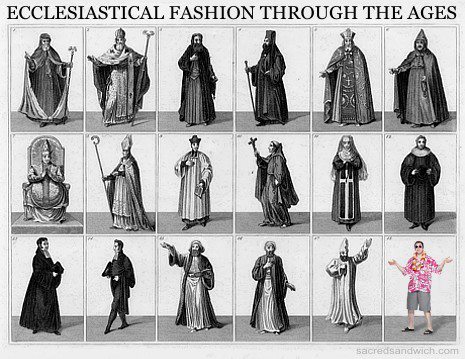
Pastor fashion?

Pastor fashion? Classic ecclesiastical wardrobes, pointed to Christ, each aspect was a story of the Gospel, something to consider…How do you point people to Christ, do you present your best, even in clothing?

The Pastors Role is to point people to Christ!

John 21:16; Acts 20:28; Ephesians 4:11-12; Titus 1:5-9; 1 Tim. 3:1-7; 4:15-16; 5:17; 2 Tim. 2:15; 4:1-5; 1 Pet. 5:1-2

Preach, teach, and point your flock to the LORD Jesus Christ and not to yourselves!

“You must not lose confidence in God because you lost confidence in your pastor. If our confidence in God had to depend upon our confidence in any human person, we would be on shifting sand.”  Francis A. Schaeffer

 We are not to point to trends or to ourselves, we are not to be sloppy in our studies or devotions, we are not to have dinner conversations in the pulpit, we are to preach!

Feed your sheep!  16 Again Jesus said, “Simon son of John, do you love me?” He answered, “Yes, Lord, you know that I love you.” Jesus said, “Take care of my sheep.” John 21:16

Shepherd your sheep! 28 Keep watch over yourselves and all the flock of which the Holy Spirit has made you overseers. Be shepherds of the church of God, which he bought with his own blood. Acts 20:28

Equip your people! 11 So Christ himself gave the apostles, the prophets, the evangelists, the pastors and teachers, 12 to equip his people for works of service, so that the body of Christ may be built up Ephesians 4:11-12

Be right with God! 6 An elder must be blameless, faithful to his wife, a man whose children believe and are not open to the charge of being wild and disobedient. 7 Since an overseer manages God’s household, he must be blameless—not overbearing, not quick-tempered, not given to drunkenness, not violent, not pursuing dishonest gain. 8 Rather, he must be hospitable, one who loves what is good, who is self-controlled, upright, holy and disciplined. 9 He must hold firmly to the trustworthy message as it has been taught, so that he can encourage others by sound doctrine and refute those who oppose it. Titus 1:5-9

Have Character and Fruit of the Spirit! 3 Here is a trustworthy saying: Whoever aspires to be an overseer desires a noble task. 2 Now the overseer is to be above reproach, faithful to his wife, temperate, self-controlled, respectable, hospitable, able to teach, 3 not given to drunkenness, not violent but gentle, not quarrelsome, not a lover of money. 4 He must manage his own family well and see that his children obey him, and he must do so in a manner worthy of full respect. 5 (If anyone does not know how to manage his own family, how can he take care of God’s church?) 6 He must not be a recent convert, or he may become conceited and fall under the same judgment as the devil. 7 He must also have a good reputation with outsiders, so that he will not fall into disgrace and into the devil’s trap. 1 Timothy 3:1-7

Do your best due diligence! 15 Be diligent in these matters; give yourself wholly to them, so that everyone may see your progress. 16 Watch your life and doctrine closely. Persevere in them, because if you do, you will save both yourself and your hearers. 1 Timothy 4:15-16

Be worthy! 17 The elders who direct the affairs of the church well are worthy of double honor, especially those whose work is preaching and teaching. 1 Timothy 5:17

Teach true Truth! 15 Do your best to present yourself to God as one approved, a worker who does not need to be ashamed and who correctly handles the word of truth. 2 Timothy 2:15

Preach and teach correctly! 2 Preach the word; be prepared in season and out of season; correct, rebuke and encourage—with great patience and careful instruction. 3 For the time will come when people will not put up with sound doctrine. Instead, to suit their own desires, they will gather around them a great number of teachers to say what their itching ears want to hear. 4 They will turn their ears away from the truth and turn aside to myths. 5 But you, keep your head in all situations, endure hardship, do the work of an evangelist, discharge all the duties of your ministry. 2 Timothy 4:1-5

Point to Christ as LORD! 5 To the elders among you, I appeal as a fellow elder and a witness of Christ’s sufferings who also will share in the glory to be revealed: 2 Be shepherds of God’s flock that is under your care, watching over them—not because you must, but because you are willing, as God wants you to be; not pursuing dishonest gain, but eager to serve;… 1 Peter 5:1-2

Pastors, you must teach the Bible in full clarity with power, conviction and in the full true Truth. If not, then quit…and go sell insurance….run do not walk to the nearest exit, leave, vamoose, hit the road, and give your pulpit to someone, who knows the Word, loves the Lord and who will preach Truth, teach and disciple! Why? For the reason, you are not a ‘real’ pastor, in the biblical sense, who is called to equip, inspire and train; rather, you are just a noise of 1 Cor. 13:1….

Research on Spiritual Maturity and its Importance

Research Conducted between 2002 and 2007:

We recently rested these statistics with no significant variation….so the same as today, no real improvements in the church today…

· Sixty-percent (60%) of the church leaders and pastors surveyed said that more than 60% of their congregational members do not have an accurate view of biblical truths.

· Sixty-percent (60%) of the church leaders and pastors surveyed said that more than 60% of their congregational members do not have an accurate view of their personal spiritual growth. They believe they are growing, but put little to no effort into their growth. Thus, their feelings are in contradiction to fact as perceived by the pastors.

· Fifty-six percent (56%) of the church leaders and pastors surveyed said that more than 60% of their congregational members consider themselves as conservative Christians but do not practice that in how they talk, behave, or vote in elections.

How sad it is when Christians go un-discipled because they do not think it is necessary or important or relevant—to miss the fact that Christ Himself tells us that the chief role and duty of a church is to train and disciple its people so they can know and grow in Christ and thus be an impact in the world. When we do not do this, we end up useless, as leftover crumbs under the feast table of the kingdom. Perhaps some milk has been drunk, but no meat, no impact, no worthiness of contact of our life in Him to our situation and opportunities, so we miss out on the marvels of being used in His kingdom (Matt. 28:11-20; 2 Cor. 5:20; Heb. 4:11).

Research from 1996- 2007, R. J. Krejcir, Ph.D., Francis A. Schaeffer Institute of Church Leadership Development www.churchleadership.org

Spiritual Maturity Builds Churches PIII

The Importance Of Our Motivation and Inspiration

Therefore I will give him a portion among the great, and he will divide the spoils with the strong, because he poured out his life unto death, and was numbered with the transgressors. For he bore the sin of many, and made intercession for the transgressors. Isaiah 53: 12

I live in the Los Angeles area, the home of a basketball team called the “Lakers,” even though there is no lake. Anyway, they are one of the top teams in the league, with several championship wins, and usually have two or three exceptional star players. During the end of the regular season in 2004, the Lakers were losing. They had to win two very important games with teams I had never heard of (what can I say, I am just not much of a sports guy when it comes to “foreign” teams), or they would not be in the finals. Then, for the key game, one of their star players, Kobe Bryant, just did not show up. The team was down and unmotivated. Their coach, Phil Jackson, took the rest of the twelve players into the locker room and told them that each one of them had the capability to win. Together, they could win without that star player, or any star player. Then he told them, you have become lazy, relying on Kobe and Shaq and not stepping up yourselves. Then he said, “you all must step up and perform.” They went out, and won.

Do you “step up?” What motivates you in the Christian life?

What is your source of inspiration outside of the Scriptures? Do you just rely on others, or do you and can you “step up” in your faith, reaching out to others to win the game that Christ has put you in? The key to stepping up is motivation. Coach Jackson is a skilled motivator, which is why he has a lot of championship rings. We do not need the ring when we know who we are in Christ and when He is our motivation!

He replied, “Because you have so little faith. I tell you the truth, if you have faith as small as a mustard seed, you can say to this mountain, ‘Move from here to there’ and it will move. Nothing will be impossible for you.” Matthew 17:20

Most of us will look to our creeds and confessions for motivation, and for good reason. But, I want to extend further into our personal responsibility. That is, how can we take our faith so seriously that it becomes more personal and real, and all our thoughts, ideas, directions, goals, and inspirations go in the direction of serving our Lord? How do we take our faith to a deeper level, “step up” so it is ours and personal, and not just because this is what our families are and do, and not just because we are part of a good church, school, or work? How do we “step up” so that our faith is solely because of what Christ has done for us and nothing else?

The key is in allowing the work of the Holy Spirit in us. However, we have a responsibility to respond, to grow, and to build on what we are given. It takes trust, faith, and the surrender of our will, our dreams, and our ideas over to the LORDSHIP of Christ. We must acknowledge that He is Lord of us because of His love for us, and that His ways are better than ours. Christ is our King; so, let us live our lives in response to what He has done for us!

© 1992, 2005, Richard J. Krejcir, Ph.D. Schaeffer Institute of Church Leadership, www.churchleadership.org